


Engraving tools for metal are used in many areas, such as jewelry making, watchmaking, industrial marking, and the production of personalized products. The right tool can significantly improve the quality, speed, and precision of your work.
In this guide, we will introduce the different types of tools and show you how to choose the right model for your project. This involves considering the workpiece, the material used, and the desired result. Whether you work professionally or only occasionally with metal, here you will find practical decision-making assistance for the best metal engraving tool.

In this article:
- Part 1: Laser Engraving Machines for Metal
- Type 1: Blue Diode Lasers
- Type 2: IR Laser Engravers
- Type 3: Fiber Laser Engravers
- Part 2: CNC Engraving Machines for Metal
- Part 3: Hand Tools for Metal Engraving
- Part 4: Electric Engraving Tools for Metal
- Part 5: How to Choose the Right Metal Engraving Tool
- Part 6: FAQ on Engraving Tools for Metal
Part 1: Laser Engraving Machines for Metal
Laser engraving machines for metal use focused light to mark, engrave, or cut metal. They work with extreme precision and are suitable for intricate designs that would be difficult to achieve by hand. These devices can be used for small creative projects as well as industrial applications. The best laser depends on the type of metal and the desired level of detail.
Advantages of Laser Engraving on Metal
- High Precision: Fine lines, detailed images, and easily readable texts can be precisely implemented.
- Non-Contact Processing: Since no tool presses on the surface, there is no tool wear or mechanical stress on the workpiece.
- Fast and Reproducible: This method is excellent for producing many identical workpieces in a short time.
- Versatile: Depending on the laser source, different metals and other materials can be processed.
Type 1: Blue Diode Lasers
Blue diode lasers are particularly suitable for coated metals, such as painted or anodized surfaces. Bare, uncoated metal, however, can only be directly engraved to a limited extent with these lasers. For painted or anodized workpieces, they are a practical and cost-effective solution.
Type 2: IR Laser Engravers
IR lasers can directly mark metal without an additional coating. They are suitable for stainless steel and aluminum, among other materials, and produce clean, permanent markings. This makes them a good choice for precise metal marking and etching on compact workpieces.
Type 3: Fiber Laser Engravers
Fiber lasers are more powerful and are often offered with 20 W or more. This allows them to engrave deeper and even cut thin metal sheets. Compared to IR diode lasers, they work faster and achieve greater engraving depths. This makes them ideal for industrial applications where durable and high-contrast results are required.
The Best Laser Engraving Machines for Metal
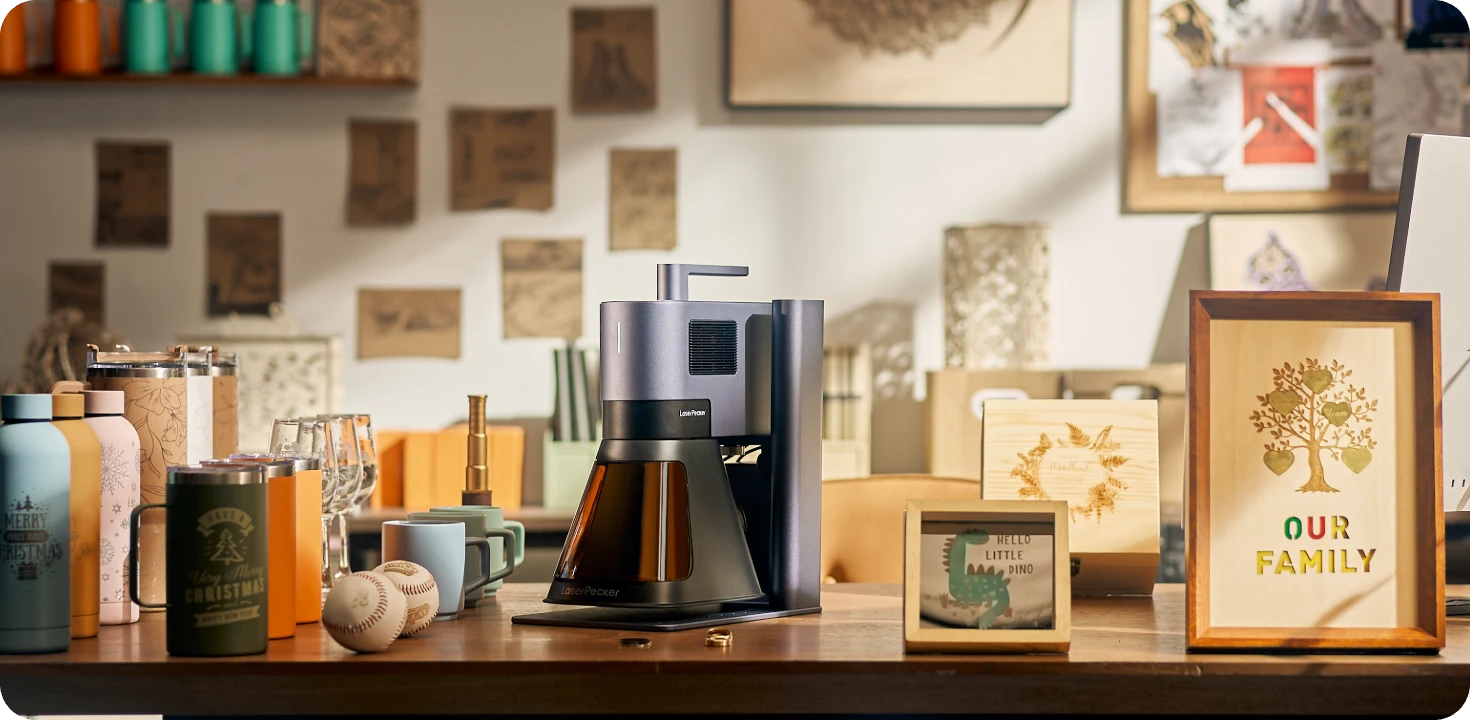
The LaserPecker LP5 is a versatile and robust solution for workshops and businesses. Its 20W fiber laser and 20W diode laser (1064 nm and 450 nm) process both coated and bare metals. Its features include:
- Compact and Powerful: The device is easy to move and still offers enough power for various tasks.
- Fast Engraving: With speeds of up to 10,000 mm/s, it is suitable for both individual pieces and larger quantities.
- Deep Engraving on Metal: Various metals can be deeply engraved, creating particularly durable markings.
- 3D Coin Reliefs: Detailed 3D reliefs can be created on coins and other metal objects.
- Metal Cutting: Aluminum, copper, and stainless steel sheets up to 1 mm thick can be precisely cut.
- Color Engraving on Stainless Steel: Durable color effects can be produced on stainless steel surfaces.
- Practical Accessories: The Slide Extension expands the work area to 160 × 300 mm. The Rotary Extension allows for engraving round objects like cups and rings.
- User-Friendly Software: The device is compatible with LightBurn and LaserPecker Design Space, making design preparation straightforward.
- Safe Indoor Use: In combination with a safety enclosure, a Class 1 laser system can be set up for studios and workshops.
Part 2: CNC Engraving Machines for Metal
CNC engraving machines are automated tools that precisely process metal based on digital design data. They deliver consistent results for repetitive tasks and are therefore particularly suitable for serial numbers or larger quantities of identical components. With CNC machines, complex 2D and 3D patterns can be created that would be very difficult to achieve by hand. They are used in ambitious hobby workshops as well as in professional businesses.
Advantages of CNC Metal Engraving
- Automation: Reduces manual labor and potential errors.
- Consistent Results: Ideal for serial numbers, uniform brand marking, and mass production.
- Complex Designs: Enables sophisticated 2D and 3D motifs that are difficult to create manually. Scalability: Suitable for small and large production volumes.
Part 3: Hand Tools for Metal Engraving
Hand engraving requires a lot of practice and craftsmanship. With tools like gravers and chisels, designs are worked directly into the metal. Artists can thereby create a personal signature and surface textures that are difficult to replicate mechanically. The process takes longer than machine processing but offers a lot of control over line depth and expression. It is excellently suited for individual pieces of jewelry and decorative metalwork.
Advantages of Manual Metal Engraving
- Artistic Freedom: Individual structures, patterns, and fine details can be freely designed.
- Unique Workpieces: Each engraved object can become a unique piece.
- Direct Control: The depth and quality of each line can be finely controlled during work.
Part 4: Electric Engraving Tools for Metal
Electric engraving tools make work easier with vibrating or rotating tips. They reduce physical strain and are well suited for small tasks or repetitive patterns. Different attachments can usually be used to create various effects and designs. Thus, electric tools combine the direct control of handwork with a higher working speed.
Advantages of Electric Metal Engraving Tools
- Less Fatiguing: Even longer engraving is possible with less effort.
- Fast Work: Well suited for repetitive designs and small corrections.
- Interchangeable Attachments: Various tips allow for different lines, patterns, and surfaces.
Part 5: How to Choose the Right Metal Engraving Tool
The appropriate engraving method depends on the material, the desired engraving depth, and the required quantity. Budget and precision requirements also play an important role. Hand tools are particularly suitable for artistic unique pieces, while laser and CNC machines are useful for commercial or industrial applications. Those who know the respective strengths will achieve a clean and durable result faster.
Material Compatibility
When choosing, consider which metal you want to process – for example, stainless steel, aluminum, brass, or coated metals.
- Diode lasers generally only work reliably on metal if the surface is painted or coated.
- IR lasers are suitable for direct marking of bare metals.
- Fiber lasers are ideal for deep or industrial engravings and produce particularly durable, high-contrast results.
Other tools each have their own strengths:
- Hand engraving tools allow for artistic designs on almost any metal, but require practice and are time-consuming for large orders.
- Electric engraving devices are practical for small tasks and quick corrections, but do not achieve the depth and precision of professional laser systems on hard metals.
- CNC engraving machines process bare metals with high repeatability. However, they require more setup, space, and budget, and are therefore often less suitable for small hobby projects.
These differences help you choose the right tool based on material, design, and production volume.
Engraving Depth and Durability
Consider how deep and durable the marking needs to be. For a light, decorative marking, a compact laser or hand tool may suffice. For deep, heavily used engravings, however, a fiber laser or a CNC machine is more suitable.
Budget and Production Volume
Align the investment with your planned projects. For small jobs or occasional use, hand and electric tools offer an affordable entry point. For high volumes and professional manufacturing, CNC and fiber laser systems are usually the more efficient choice.
Precision and Detail Requirements
The finer the design, the more important the precision of the tool. Laser and CNC machines offer high accuracy and repeatability. Hand tools, on the other hand, allow for more artistic freedom and an immediate feel for the material.
Part 6: FAQ on Engraving Tools for Metal
1. Can any laser mark bare metal?
No. A blue diode laser with about 450 nm usually only works reliably on metal if the surface is painted or coated. IR lasers with 1064 nm and fiber lasers can directly mark bare metal without an additional coating. Fiber lasers also offer enough power for deep engravings and can even cut thin metal sheets. Therefore, choosing the right laser source is crucial for a clean, permanent marking.
2. What is the difference between CNC metal engraving and hand engraving?
CNC machines deliver reproducible results with each pass. This is ideal for serial numbers, logos, and industrial markings. Hand engraving, on the other hand, focuses on artistic design: individual structures and fine details can be directly worked into the workpiece. Many professionals combine both methods – CNC for the basic shape and handwork for finishing and personal details.
3. Why is the LP5 suitable for industrial and professional applications?
The LP5 combines a 20W fiber laser with a 20W diode laser, allowing it to process both bare and coated metals. With an engraving speed of up to 10,000 mm/s, it is designed for fast production. The device handles deep engravings, 3D reliefs, and cutting of metal, wood, acrylic, and other materials. Optional accessories like the Slide Extension expand the work area, while the Rotary Extension enables processing of round objects. Together with suitable software and a safety enclosure, the LP5 is a powerful solution for studios, workshops, and businesses with regular engraving needs.
Conclusion
To choose the best metal engraving tool, you should consider the material, desired engraving depth, production volume, and precision requirements. Hand tools allow for individual, artistic details. Electric tools work faster and are easier to use. CNC systems deliver consistent results for serial work. Metal lasers like the LP5 combine power and versatility with professional quality.
Knowing the strengths of each tool will help you find the right solution for everything from simple hobby projects to industrial production. Depending on the task, several methods can also be combined. With the right tool, precise, attractive engravings are created, and experience in handling it facilitates future projects.


